- Home
- Brain Games
Free Online Brain Games: What the Research Says
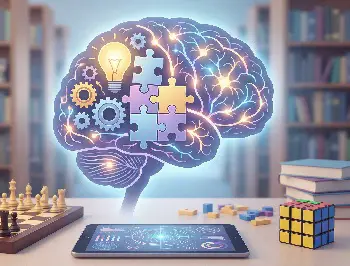
Here's the honest truth about brain games: they won't turn you into a genius, but they're not snake oil either.
Recent meta-analyses confirm what researchers have suspected for years. Online brain games can improve specific cognitive skills like processing speed, working memory, and attention. What they probably won't do is boost your general intelligence or prevent dementia on their own.[1]
That's actually good news. It means you can enjoy these games for what they are: engaging and stimulating mental activities ("cognitive snacks") that exercise particular brain functions. Think of them as targeted workouts for your mind, not miracle cures.
Looking for the games themselves? Right here:
► Browse All 200+ Free Brain Games
By Type: Board Games • Card & Tile • Concentration • Math Games • Memory • Puzzles A-M • Puzzles N-Z • Time Management • Word Games
Popular: Bubble Pop • Sudoku • Mahjong • Solitaire • Tetris • Checkers • Printable Crossword Puzzles • Typing
More: Newest • Most Popular • Multiplayer • Retro Flash Games
I've been curating free online brain games on this site since 2007. Over that time, I've watched the research evolve from wild claims to more nuanced findings. This page explains what the science actually shows, which skills different games target, and how to get the most from brain training. Then you can dive into the 200+ games available here, all free and requiring no login.
What the Research Actually Shows

The brain training industry has made bold claims over the years, some of which haven't held up to scrutiny. But dismissing brain games entirely would be throwing out the baby with the bathwater. Here's what well-designed studies have found:
Games improve the specific skills they train. A 2025 meta-analysis reviewing 16 randomized controlled trials found statistically significant improvements in cognitive functioning, working memory, and processing speed among healthy individuals who used brain training games.[1] A 2020 meta-analysis in Scientific Reports found similar results in older adults, with significant improvements in processing speed, working memory, executive function, and verbal memory.[2]
The improvements are real but targeted. A 2021 meta-analysis looking specifically at game-based brain training in older adults found effect sizes of 0.23 for processing speed, 0.40 for selective attention, and 0.35 for short-term memory. These are modest but meaningful improvements, and they occurred in the specific domains that the games targeted.[3]
Transfer to untrained skills is limited. This is where the research gets complicated. While people get better at the specific games they play and at closely related tasks, the evidence for "far transfer" (improvements in completely different cognitive domains or real-world functioning) is weaker. A large-scale 2019 study found that brain training showed benefits over extended periods, but these were concentrated in working memory and verbal skills rather than general reasoning.[4]
Medical organizations see value for at-risk populations. The American Academy of Neurology's 2018 guidelines for mild cognitive impairment stated that "cognitive training may improve cognitive measures" and suggested clinicians may recommend it.[5] The National Academies of Sciences, Engineering, and Medicine identified cognitive training as one of only three interventions with encouraging (though not conclusive) evidence for preventing cognitive decline.[6]
Regular video games show some surprising benefits too. Some of the most intriguing cognitive findings come not from purpose-built brain training software but from regular commercial games. University of Rochester researchers trained non-gamers on action games for 50 hours and found they made accurate decisions up to 25% faster than a control group, with no loss in accuracy. Their brains had become more efficient at gathering sensory information and reaching correct conclusions.[7]
At UC Irvine, students who played the 3D game Super Mario 3D World for 30 minutes a day over two weeks improved their performance on hippocampal memory tests by about 12%. That's roughly the same amount this type of memory normally declines between ages 45 and 70. Students who played the 2D game Angry Birds showed no such improvement, suggesting that the spatial complexity of 3D environments provides unique stimulation for the brain's memory centers.[8]
Perhaps most unexpectedly, Italian researchers found that 12 hours of action video game play improved reading speed in children with dyslexia as much as, or more than, a full year of spontaneous reading development. It matched the results of intensive traditional reading programs, apparently by training visual attention rather than reading skills directly. The finding was later replicated with English-speaking children.[9]
The Honest Bottom Line
I've been writing about memory and brain health since 2006, and I've watched the brain training industry go through cycles of hype and backlash. The truth, as usual, lies somewhere in the middle.
Brain games are not going to prevent Alzheimer's or make you smarter in some general sense. They are not a substitute for the lifestyle factors that have stronger evidence behind them: regular exercise, adequate sleep, good nutrition, and stress management. If you're looking to protect your cognitive function long-term, start there.
But brain games are not worthless either. They provide genuine cognitive engagement, they can help maintain specific skills as we age, and they're a lot more mentally stimulating than scrolling through social media or watching television. I think of them as cognitive snacks: enjoyable, mildly beneficial, and best consumed as part of a balanced mental diet that includes learning new things, staying socially connected, and keeping physically active.
For more on improving your memory through proven techniques, see the Memory Skills section. For lifestyle factors that support brain health, see Brain Health. If you're concerned about cognitive decline, talk to your doctor.
What Different Games Train
Different games exercise different cognitive functions. If you want to target specific skills, here's what the research suggests about which game types train which abilities:
Working Memory
Games that require you to hold information in mind while manipulating it. This includes matching games where you must remember card locations, sequence games like Simon, and n-back style tasks. Working memory is fundamental to many cognitive functions and tends to decline with age. Research also suggests that spatially complex 3D games may uniquely stimulate the hippocampus, the brain region most associated with forming new memories.[8]
Try: Memory Games | Casino Cards Matching | Simon Memory
Processing Speed
Games that require quick visual identification and rapid responses. Fast-paced action games, timed puzzles, and reaction-based challenges all fall into this category. Research shows this is one of the cognitive domains most consistently improved by game-based training.[2]
Try: Concentration Games | Atari Asteroids | Whack-A-Mole | Tetris
Attention and Focus
Games requiring sustained concentration, visual tracking, and filtering out distractions. Shooter games, tracking games, and games with multiple simultaneous demands train these skills.
Try: Bubble Shooter | Cube Field | Gold Miner
Problem Solving and Reasoning
Strategy games, logic puzzles, and games requiring planning ahead. Chess, checkers, and puzzle games that require figuring out sequences of moves all exercise these functions.
Try: Puzzle Games | Chess | Checkers | Bloxorz | Sudoku
Verbal Skills
Word games, crosswords, and vocabulary challenges. These exercise language processing, word retrieval, and verbal fluency.
Try: Word Games | Outspell Scrabble | Crosswords | Printable Biology Crosswords | Hangman
Mental Flexibility
Games requiring task-switching, adapting to changing rules, or managing multiple objectives simultaneously. Time management games and games with evolving challenges train cognitive flexibility.
Try: Time Management Games | Penguin Diner | Fireboy and Watergirl
How to Get the Most from Brain Games
If you're going to play brain games, you might as well do it in a way that maximizes any potential benefit. Here's what the research and common sense suggest:
Play a variety of games. Since different games train different skills, rotating through various types gives your brain a more complete workout. Don't just play Sudoku every day; mix in word games, memory games, and action games.
Challenge yourself appropriately. Games that are too easy don't provide much stimulation. Games that are impossibly hard are just frustrating. Look for that sweet spot where you're challenged but can still make progress. Many games have difficulty levels; use them.
Be consistent rather than intensive. Research suggests that moderate, regular sessions (around 30-60 minutes, a few times per week) may be more beneficial than marathon sessions.[3] Build brain games into a routine rather than binging occasionally.
Combine with lifestyle factors. Brain games work best as part of an overall approach to cognitive health. Don't let them be your only strategy. A 30-minute walk may do more for your brain than another hour of Sudoku.
Enjoy yourself. If you hate the games you're playing, you won't stick with them. Find games you actually enjoy. Compliance matters, and you're more likely to maintain a habit that's genuinely fun.
Browse the Games
Ready to play? Browse all 200+ free brain games available on this site. No registration or login required. Just click through to a game page and start playing.
Important: Brain games are for general cognitive engagement and entertainment. They do not diagnose, treat, or prevent any medical condition. If you have concerns about memory loss or cognitive decline, please consult a healthcare professional. See my Medical Disclaimer and Editorial Standards.
References & Research
I've reviewed these sources and selected them for their relevance to understanding what brain training can and cannot do. Here's what each contributes:
1. Somaa, F., Khan, A., & Arafah, A. (2025). "Efficacy of Brain Training Games on the Cognitive Functioning, Working Memory and Processing Speed of Healthy Individuals: A Meta-Analysis." Journal of Pharmacy and Bioallied Sciences, 17(Suppl 2), S1719-S1723. Free full text at PMC
Researcher's Note: This is the most recent comprehensive meta-analysis I've found, reviewing 16 randomized controlled trials from 2000-2024. The findings support that brain training games produce statistically significant improvements in cognitive functioning, working memory, and processing speed. However, the authors note that some studies found aerobic exercise equally or more effective, which aligns with what I've seen in other research.
2. Bonnechère, B., Langley, C., & Sahakian, B.J. (2020). "The use of commercial computerised cognitive games in older adults: a meta-analysis." Scientific Reports, 10, 15276. Free full text at Nature
Researcher's Note: This meta-analysis from Cambridge researchers looked specifically at commercial brain games (the kind you'd actually download and use) in adults over 60. They found significant improvements in processing speed (SMD 0.40), working memory (0.21), executive function (0.21), and verbal memory (0.12). Notably, they did not find significant improvements in attention or visuospatial abilities, though they note only four studies addressed each of those domains.
3. Wang, G., Zhao, M., Yang, F., Cheng, L.J., & Lau, Y. (2021). "Game-based brain training for improving cognitive function in community-dwelling older adults: A systematic review and meta-regression." Archives of Gerontology and Geriatrics, 92, 104260. Abstract at PubMed
Researcher's Note: No free full-text version of this paper is available online, but the PubMed abstract includes the key findings cited on this page: effect sizes of g = 0.23 for processing speed, 0.40 for selective attention, and 0.35 for short-term memory. The abstract also reports the practical subgroup findings: non-time-pressure games, multiplayer formats, computer platforms, and sessions three times per week or fewer at 60 minutes or less were the most effective designs. This suggests moderate, regular play beats intensive cramming.
4. Hampshire, A., Sandrone, S., & Hellyer, P.J. (2019). "A Large-Scale, Cross-Sectional Investigation Into the Efficacy of Brain Training." Frontiers in Human Neuroscience, 13, 221. Free full text at PMC
Researcher's Note: This large study (N = 60,222) from Imperial College London offers a nuanced picture. People who had just started brain training actually scored lower than non-trainers on cognitive tests, but those who had trained for a year or more showed higher working-memory and verbal scores. Interestingly, regular computer and board games showed stronger associations with cognitive scores than commercial brain training programs. The authors suggest the social and engagement aspects of traditional games may matter.
5. Petersen, R.C., Lopez, O., Armstrong, M.J., et al. (2018). "Practice guideline update summary: Mild cognitive impairment." Neurology, 90(3), 126-135. Free full text at PMC
Researcher's Note: The American Academy of Neurology's official guidelines stated that "cognitive training may improve cognitive measures" in patients with mild cognitive impairment (Level C recommendation). They gave a stronger recommendation (Level B) for exercise. Note: This guideline was retired in 2024, but it remains one of the few official medical recommendations that addressed cognitive training.
6. National Academies of Sciences, Engineering, and Medicine. (2017). Preventing Cognitive Decline and Dementia: A Way Forward. Washington, DC: The National Academies Press. Free full text at NCBI Bookshelf
Researcher's Note: This consensus report identified only three intervention classes with "encouraging but inconclusive" evidence for preventing cognitive decline: cognitive training, blood pressure management for those with hypertension, and increased physical activity. The report was careful to note that evidence was insufficient to support a public health campaign, but appropriate for healthcare providers to mention when discussing these topics with patients.
7. Green, C.S., Pouget, A., & Bavelier, D. (2010). "Improved Probabilistic Inference as a General Learning Mechanism with Action Video Games." Current Biology, 20(17), 1573-1579. Free full text at PMC
Researcher's Note: This is one of Daphne Bavelier's key studies at the University of Rochester. Rather than just surveying existing gamers, the researchers trained non-gamers for 50 hours on either action games (Call of Duty 2, Unreal Tournament) or a slow-paced strategy game (The Sims 2), then tested decision-making. The action game group made accurate decisions up to 25% faster. The underlying mechanism: their brains became better at accumulating sensory evidence and reaching correct conclusions, a skill called "probabilistic inference" that applies well beyond gaming.
8. Clemenson, G.D. & Stark, C.E.L. (2015). "Virtual Environmental Enrichment through Video Games Improves Hippocampal-Associated Memory." The Journal of Neuroscience, 35(49), 16116-16125. Free full text at PMC
Researcher's Note: This UC Irvine study is particularly relevant to this site's focus on memory. The researchers drew on the concept of "environmental enrichment," well-established in animal research as a driver of hippocampal neuroplasticity. They found that playing the spatially complex 3D game Super Mario 3D World for two weeks improved hippocampal memory by about 12%, while playing the simpler 2D game Angry Birds did not. The finding suggests that navigating rich 3D virtual environments may stimulate the hippocampus in ways that simpler games cannot.
9. Franceschini, S., Gori, S., Ruffino, M., Viola, S., Molteni, M., & Facoetti, A. (2013). "Action Video Games Make Dyslexic Children Read Better." Current Biology, 23(6), 462-466. PubMed • Replicated in English-speaking children: Franceschini, S. et al. (2017), Scientific Reports, 7, 5863. Free full text at Nature
Researcher's Note: This is one of the most surprising findings in the gaming-and-cognition literature. Just 12 hours of action video games (Rayman Raving Rabbids on the Wii) improved reading speed in Italian dyslexic children more than a year of typical reading development, with no loss in accuracy. The mechanism appears to be attentional, not linguistic: action games train the rapid shifting of visual attention that underlies efficient reading. The 2017 replication confirmed the effect extends to English orthography, which is much more complex than Italian. I've included both citations because the original is paywalled, but the open-access replication is available at Nature.
Published: 02/23/2007
Last Updated: 02/11/2026
Newest / Popular
Multiplayer
Board Games
Card & Tile
Concentration
Daily Games
Math / Memory
Puzzles
Time Mgmt
Word Games
- Retro Flash -
Also:
Bubble Pop
• Solitaire
• Tetris
Checkers
• Mahjong Tiles
•Typing
No sign-up or log-in needed. Just go to a game page and start playing! 

Sudoku, Kakuro, Word Searches, Crosswords, Slitherlink & more!
Hundreds of printable puzzles you can download, print, and solve with pencil and paper.

Hippocampus? Working memory? Spaced repetition?
Look up memory or brain terms in the A-Z glossary of definitions.